
The [redacted] Agenda
Shared Information Through the Lens of Book Banning

I’m an avid reader. I was a bookseller on the weekends for a good chunk of the 2023-2024 school year. I had seen little to no signs of this thematic disparity in my small, San Diego Barnes & Noble.
I wondered if it was because I lived in a "blue" state. It had to be. I could remember dozens of conversations with customers of all kinds, and they loved books with these themes.
But, what if it wasn't? My location was 4.1 miles from the Point Loma Naval Base; an affluent area of the City. I can also recall the onslaught of calls for Hillbilly Elegy after J.D. Vance was announced as Donald Trump's running mate in 2024.
Still, PEN America's jeopardized themes rang through my head.
I mulled it over as I considered where to take my conversation next.
“I’m curious how this has shown up in your work,” I said, “as someone who deals with a lot of title flow.”
I looked up from my notes as I finished the prompt, passing the baton to Migell Acosta. The Director of San Diego County Library lept into action, sending pre-selected government resources into our Zoom chat as he started his spiel.
“A community’s individuals challenging reading material is not new. That goes as long as our profession has been around,” Acosta said.
I tried to school my expression, hoping that my immediate bemusement didn’t register over the shoddy connection.
Even if I wasn't convinced of it's prominence in San Diego, I knew book banning was nothing new.
In illustrating a staggering 136 percent increase in book bans during the Fall 2023 term, PEN America’s reporting both confirmed it, and pointed towards something bigger.
PEN America attributes book banning’s American roots to Thomas Morton’s 1637 work New English Canaan and its “harsh criticism” of Puritans.
Ultimately, Morton upset a group of people who maintained social status and power within his community.
As a result, his writing was banned.
Centuries later, 2023’s pre-election cycle uptick in information disparity would set a haunting precedent for the wider state of American social policy.
On January 20th, 2025, the day of his second presidential inauguration, Trump announced he would “coordinate the termination of all discriminatory programs, including illegal DEI and ‘diversity, equity, inclusion, and accessibility’ (DEIA) mandates, policies, programs, preferences, and activities in the Federal Government, under whatever name they appear.”
The removal of DEIA initiatives means more than the loss of government programming. It means the loss of themes, of stories.
Of grief and death. Sexual and sex-related content. Characters of color. Substance use and abuse. LGBTQ+ characters. Mental health disorders. Empowerment and self-esteem.

“It is not new, and, therefore, our response…it isn’t like we had to create a response out of nothing. We’ve always had [one]...” Acosta continued.
Yes, book banning is nothing new.
The anti-DEIA initiatives put into action by President Trump are.
By declaring DEIA as “illegal” and “immoral,” creatives are faced with the same problem as Thomas Morton in the 17th century. Represent these themes and risk upsetting the group of people who maintain social status and power within their communities.
The result? A chilling effect, felt in all corners of the industry.
As it turns out, San Diego was not exempt.
I reached out to six initial contacts: Director of Coronado Public Library Shaun Briley, San Diego County Supervisor Terra Lawson-Remer, children’s author and Drag Queen Lil Miss Hot Mess, San Diego’s Drag Story Hour chapter and two additional San Diego librarians.
I appreciate you reaching out to me, however currently I'm very busy at work and don't have time for any interviews.
What an interesting project! Unfortunately, I will not be available for an interview.
Unfortunately, my calendar is pretty full at the moment, so I don't think I'll be able to do an interview.
The Supervisor is unable to take the interview at this time as her calendar is full.
I would rather not be interviewed lest any of my comments be misconstrued by either side and would suggest the County Library director or another director.
After 24 exchanged emails, five interview refusals and one “return-to-sender” message from Drag Story Hour, I was told (through Supervisor Lawson-Remer’s team) that Acosta had agreed to speak with me.
I was sure this shared hesitation was not coincidental.
“We’ve always had [one]...and I'll tell you how it’s changed–Interesting,” Acosta said.
Interesting, indeed.
At that moment, I knew I stood at the precipice of something new. Something said so loudly it manifested as silence. Something that may not have been redacted from historical data, but was being actively omitted from our own narrative.
This is my attempt to piece together the state of shared information in our recent history.
This is the [redacted] agenda.

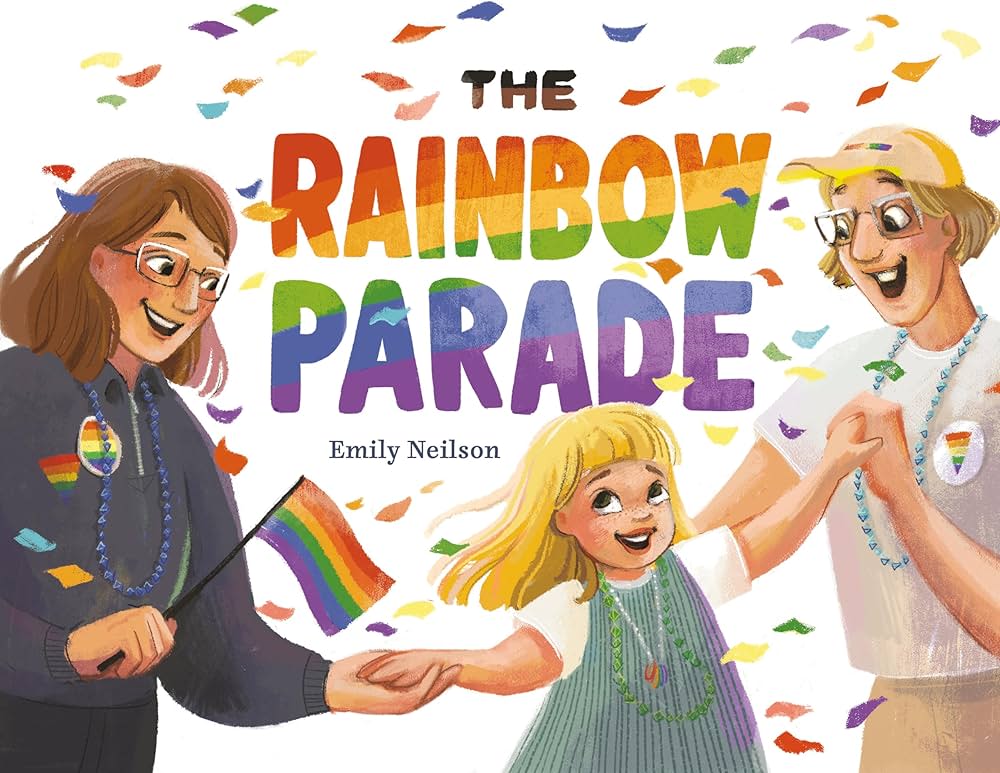
The Rainbow Parade by Emily Neilson
The Rainbow Parade by Emily Neilson

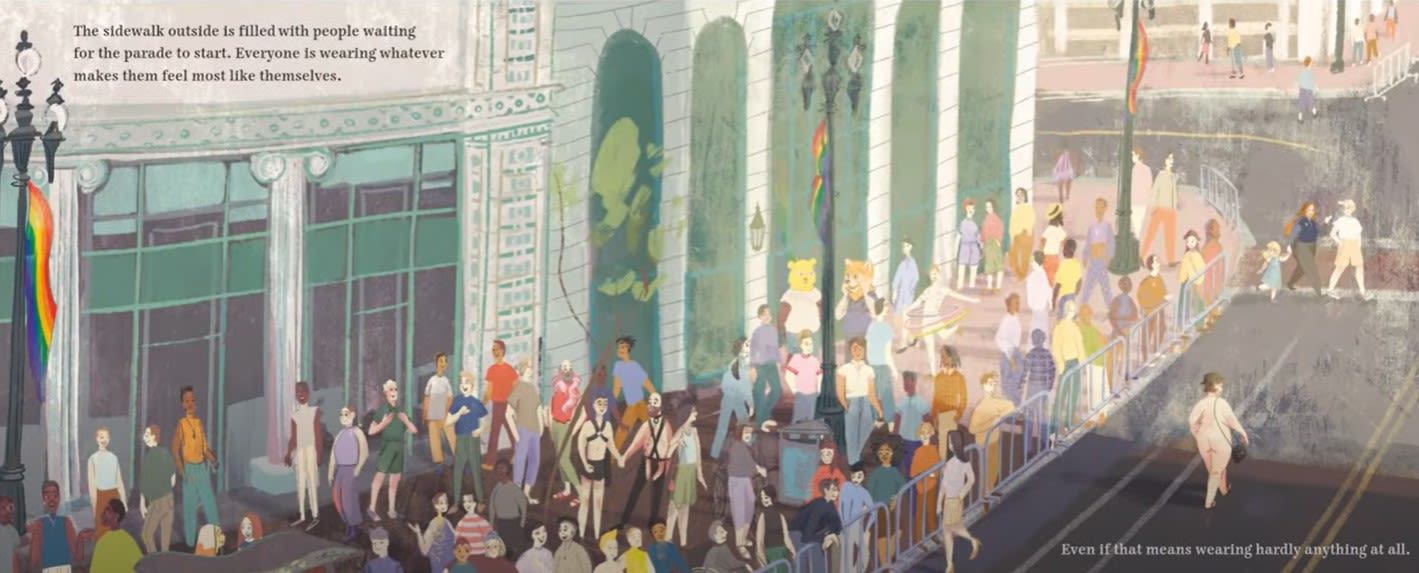
Select illustrations in The Rainbow Parade depict partial nudity
Select illustrations in The Rainbow Parade depict partial nudity
In June of 2023, the Coronado Public Library held a children’s story time event featuring The Rainbow Parade by Emily Neilson. The picture book follows a child as she attends a pride parade with her two mothers.
Generally, The Rainbow Parade is a celebration of togetherness. The synopsis says it “reminds all readers that sometimes pride takes practice and there's no ‘one way’ to be a part of the LGBTQ+ community.”
Tangentially, partial nudity is depicted in select illustrations throughout the book.
“Everyone is wearing whatever makes them feel most like themselves,” Neilson wrote. “Even if that means wearing hardly anything at all.”
The story time event sparked immediate controversy. Some community members lobbied to maintain the book’s availability at the Library, while others were disturbed by its inclusion and promotion in their collection.
After a city council meeting in July, the Library adjusted their story time protocol to provide ample time for parents to screen the books being read. However, they refused to remove any reading material from their shelves.
“We believe in the ethos of being a place for all, having a lot of viewpoints represented, and letting people curate their reading for themselves,” Coronado City Manager Tina Friend said in an interview with The Coronado Times.
Some community members were not satisfied with the changes, Coronado residents and Navy SEAL spouses Jessica Tompane and Rachel Racz included.
Tompane brought other titles, including those with sex education and LGBTQ+ themes, under fire for their “sexually-explicit” nature; effectively leading the movement to restrict books within the Library’s collection.
Racz proposed her own “pro-American, family-friendly” storytime event, Tiny Patriots Story Time, to be held at the Library.
When the Library insisted on keeping their collection as-is, and Tiny Patriots was denied by their staff, Tompane and Racz came back with a joint letter of demand.
“[Mrs. Racz and Mrs. Tompane] must be permitted to reserve and use library rooms for public reading hours that they conduct—even if the readings contain religious content,” Jeffrey Hall of Burke Law Group wrote. “We also respectfully request that the City immediately review and amend its policies surrounding the presentation and exhibition of sexually explicit materials to minors through reading hours or special displays.”
LGBTQ+ themes were never explicitly cited as their cause for concern.
In response, the Library adjusted their protocol for the second time.
Their initial denial was rooted in two requirements: the necessity of a background check to read at the Library, which would not have been possible under the time constraints of Racz’s proposal, and the religious themes of her proposed programming, which would have broken the Library’s content policy.
After reviewing their protocol, which had reportedly remained untouched since the early 80s, the Library granted Racz permission to hold Tiny Patriots meetings in their reservable spaces. However, the meetings had to be secular in nature and not advertised as a Coronado Public Library-sactioned event.
I had heard of the situation before, its significance rattling around brief conversations and brainstorms. Now reporting on it, I’ve found myself musing over one detail of Racz’s grievances: the need for “pro-America” content in the Coronado community.
So, I reached out for clarification.
“When I said pro-America, they were books about great Americans or about the American values (Family, Faith, Freedom, Independence) that I want to instill in my children,” Racz said.
While I can't say they were unexpected, her inclusion of “faith” and “freedom” had caught my attention.
Every year since 2013, the Public Religion Research Institute (PRRI) contributes to a database called the American Values Atlas (AVA). The AVA represents 50,000 annual interviews conducted within a randomly selected sample of Americans.
In 2023, the interview questionnaire included prompts on Christian Nationalism. When asked if they believed the United States would fail without Christian values, the sample, including 66% followers of Christianity or a branch thereof, erred on the side of disagreement.
The 2023 AVA is the first and only to include data on Christian Nationalism, an inclusion that suggests the PRRI recognized a change in our cultural landscape; one that began to turn away from the blending of church and state.

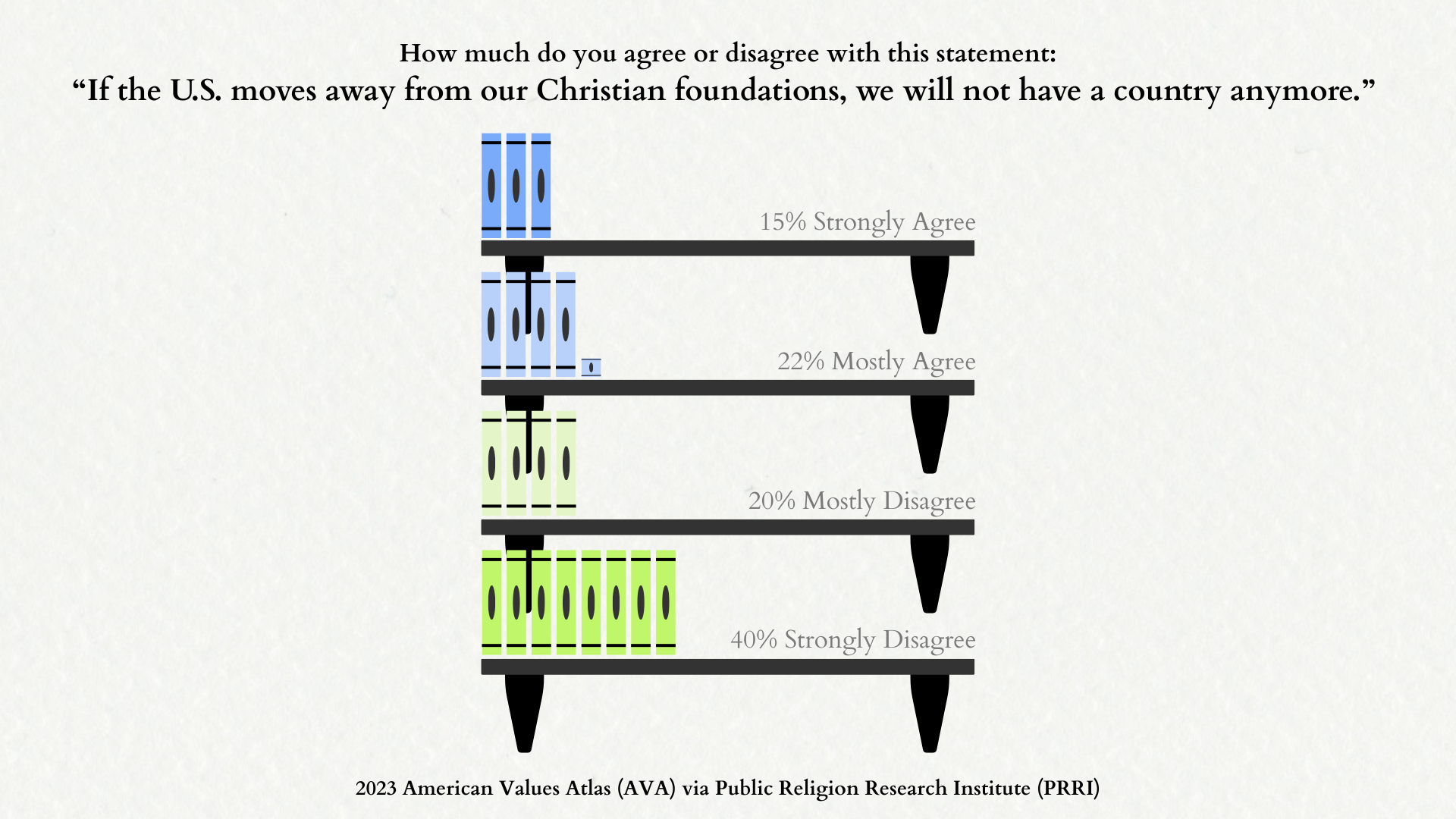
Data Visualization by Anna Locher
Data Visualization by Anna Locher
On February 7th, 2025, 18 days after his second presidential inauguration, Donald Trump signed an Executive Order to establish the White House Faith Office.
“The Office will be housed in the Domestic Policy Council and will consult with experts within the faith community and make recommendations to the President regarding changes to policies, programs, and practices to better align with the American values,” the Order states.
Weeks after rolling back DEIA initiatives, he introduced an Order to protect a community that more directly aligns with his own. The White House claimed it’s symbolic of his administration's “promises made,” and “promises kept.”
The 2023 AVA implies that religion is no longer a sole source of power within the United States. If Americans believe their nation can survive without it, it lacks the governance to warrant necessity. As a result, those who have gained positions of power from their faith, whether a politician or a community member seeking a platform, are at risk of losing them.
That is the heart of issues like these; like the one in Coronado, and like the one we see developing at a national level. When faith is misconstrued as a uniquely “American” value, it becomes a political tool rather than an extension of identity.
A hinderance to freedom. To liberty and justice for all.
When gathering information on public instances of book banning, you come into a lot of information on library operation. It’s inherent to the cause.
In my conversation with Migell Acosta, we discussed the appeal process for book challenges at the San Diego County Library: how community members can express their concerns, and how those concerns are handled by Library staff.
It comes down to a form called a “Request for Reconsideration of Library Resources,” which can be obtained by San Diego residents from librarians at each branch of the County Library.
After submission, a county-wide Intellectual Freedom Committee will reevaluate the material and consider its alignment with their Collection Development Policy. Each title in the County Library’s collection can only be evaluated once per year.
“We give a due deliberation, everybody on that committee reads the material,” Acosta said. “We look at how widely held it is. We have national databases…”
We touched on the themes of these reports, and what he has seen change in his almost 30 years of librarianship.
“The number of challenges…we get spikes around pride month celebrations. And then, upward trends year after year. Not a huge trend upward, but definitely upward…as it’s been in the Press so much,” Acosta said.

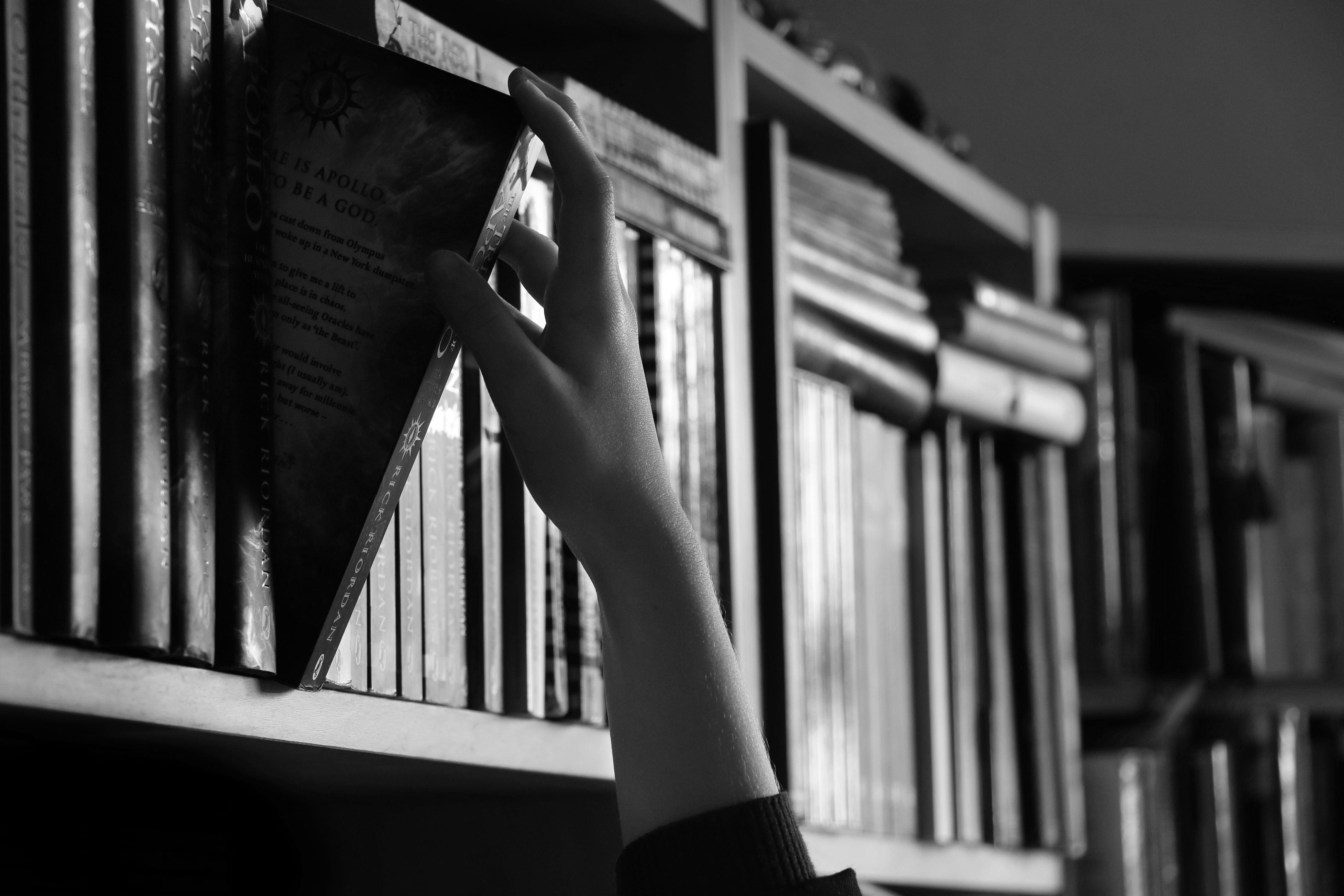
His admission reminded me of a report from the American Library Association (ALA).
“Though the number of reports to date has declined in 2024, the number of documented attempts to censor books continues to far exceed the numbers prior to 2020,” ALA wrote. “Additionally, instances of soft censorship, where books are purchased but placed in restricted areas, not used in library displays, or otherwise hidden or kept off limits due to fear of challenges illustrate the impact of organized censorship campaigns on students’ and readers’ freedom to read.”
I realized that change isn’t always a result of situations as contended as children’s story times in Coronado. Sometimes, the difference in cultural landscape is evident enough through natural integration.
To better understand the phenomenon, I headed to my local Library: the Point Loma Hervey branch of the San Diego Public Library.
A "natural sound" narrative podcast by Anna Locher
After spending 20 minutes in the space, I marveled at the fact that the only hint of controversy existed in the back corner of the second floor, on a mass-produced piece of poster paper.
My reflection was then contradicted by recollection. Acosta had opened our conversation with an interesting sentiment.
“Another way to look at library work is that it’s a helping profession,” Acosta said. “We’re professional helpers. So we listen really good, we try to understand what people want, and we try to look after resources.”
This place is a resource. The people who exist within it, cultivate it, are responsible for resourcing themselves.
They aren’t creating marketable displays in the ways I had as a bookseller, no. Their job is to provide for their population. If that means posters to display consistent programming, and clear backpacks with emotional regulation tools, then so be it.
That freedom to change, to fit needs as they arise; that is the true purpose of these spaces.

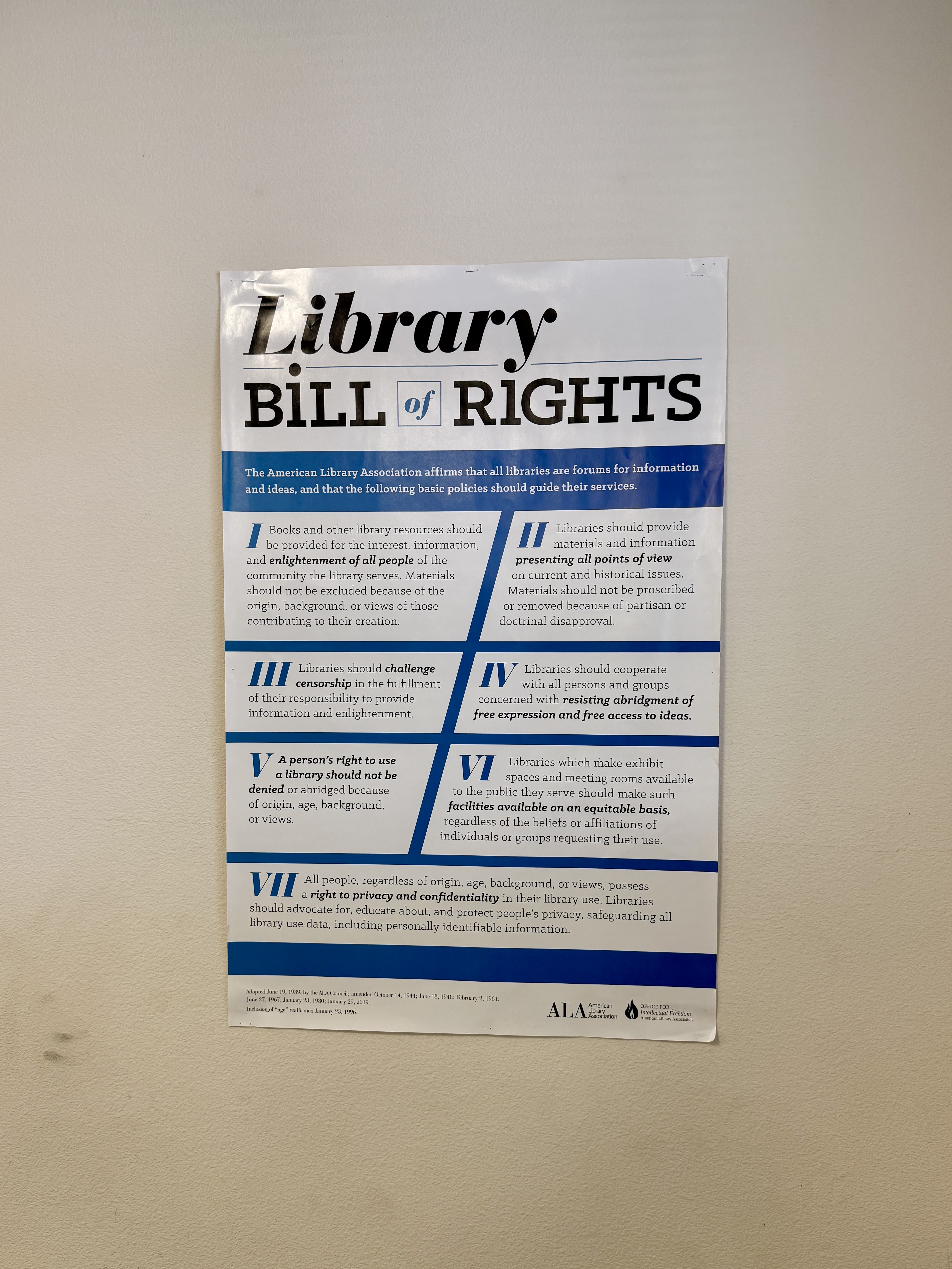
An American Library Association poster displayed at the San Diego Public Library
An American Library Association poster displayed at the San Diego Public Library

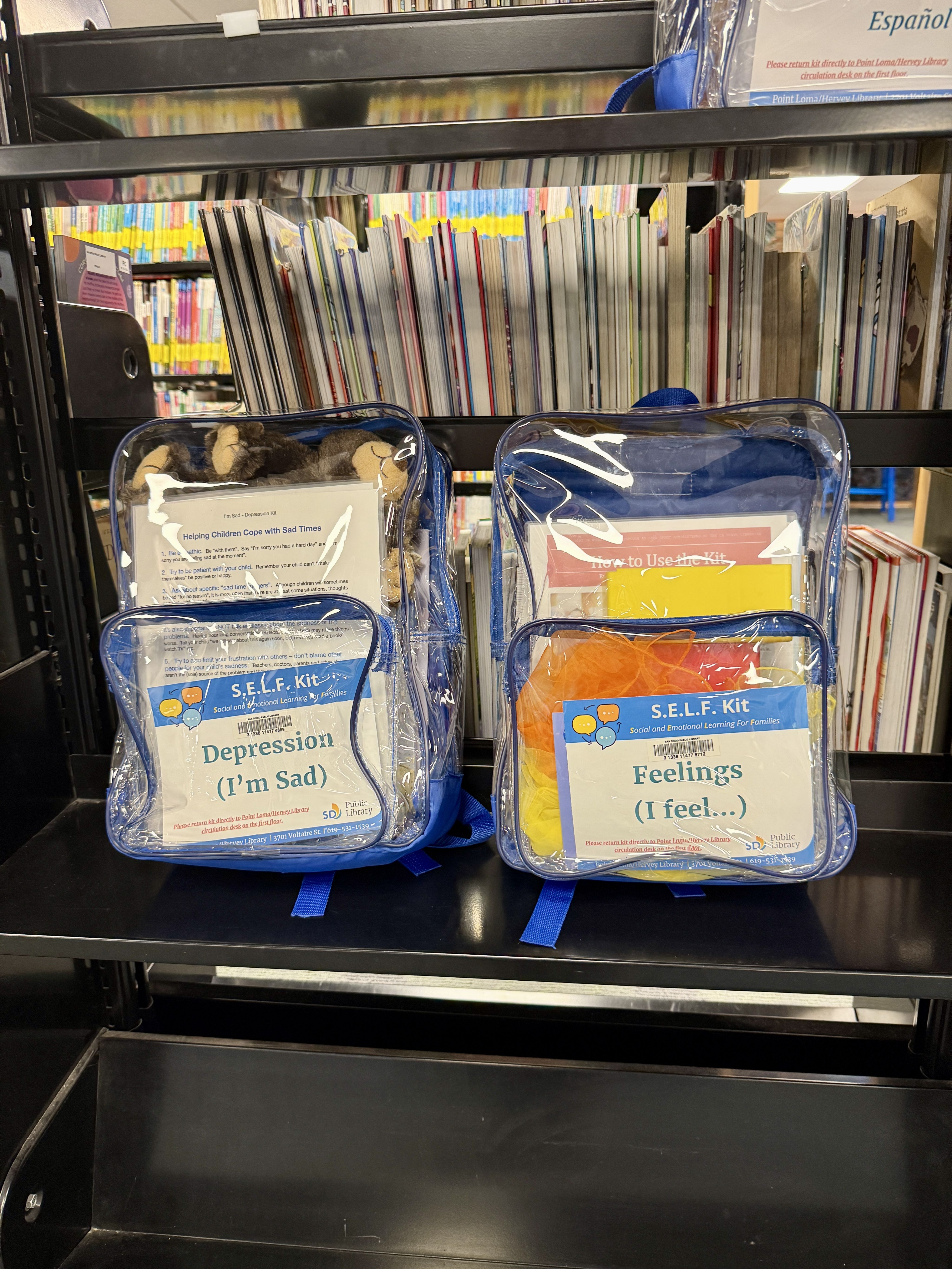
S.E.L.F Kits made available by the San Diego Public Library
S.E.L.F Kits made available by the San Diego Public Library
Sitting in my University library seemed to reinforce that idea.
“It doesn't matter what your major is, it doesn't matter, you know, whether you're a first year student or you're a grad student or or you're a faculty member, like, what's here is yours. And I really love the egalitarian nature of that,” Denise Nelson, Associate Dean of Point Loma Nazarene University’s Ryan Library, said.
Nelson was the first to admit University libraries are different from their public counterparts. They serve entirely different populations, and therefore, must approach their job in different ways.
The resourcing, however, is all the same.
“People are here to study, people are here, obviously, for tutoring or for writing help, also for their research,” Nelson said. “There are just so many things that might be the need.”
That need is where information sharing, the accessibility of resources, books, comes into play.
“We, occasionally, have had folks who are connected to someone on campus, but who aren’t really members of the campus population, who will walk by current periodicals as say, ‘I can’t believe you would have this out here.’ So we’ll talk it through, ‘This is the program that resources serves,’” Nelson said. “While it may include content that is not what we would produce as relevant content for the discipline, for a student to be educated in that area, access to this kind of resource is important.”
Nelson mused on the few instances when Ryan Library navigated challenges of this nature. In her experience, challenges were almost never instigated by Point Loma’s student population. And, when it became a matter of which population the Library would serve, the answer always came back to the one they were responsible for.
The students who’s need required access to information.
Mary Logue, Resource Discovery Librarian at Ryan Library, has studied book banning in tandem with her work at public and University libraries.
“I really like this question: Have you read the book? Because, many times, people try and ban books they haven’t read,” Logue said.
When the scope of our conversation increased beyond her own experiences, she referenced an interactive map she had seen. A map of the United States that darkens as you interact with it; a sign of the recent increases in attempted book bans around the country.
“I’m wondering, if you look at that, does that follow what’s been happening politically? I would be really interested to put those two, you know, a change in voting with the banning. I do feel, as a society, there’s a lot more controversy, a lot more harsh conversation around the topics of what’s getting banned,” Logue said.
Just a few weeks prior to my interviews with Nelson and Logue, on March 14th, 2025, President Trump signed another Executive Order.
“The non-statutory components and functions of the following governmental entities shall be eliminated to the maximum extent consistent with applicable law,” the Order states.
The Institute of Museum and Library Services was included in the cuts.
“My sense from looking at the national landscape is that issues of control in a lot of ways are becoming increasingly intense. And so that gets reflected in a lot of ways, whether that's controlling who gets to live in a neighborhood, who gets to stay in a community, who gets access to legal processes or what kind of information is available to people. That is an alarming trajectory,” Nelson said.
So, yes, libraries are a resource. They are resources for the communities they serve. Their responsibility rests in discernment, and their ability to adapt to the landscape around them.
My reporting has led me to believe that they operate off principles of freedom. The freedom to listen, the freedom to change.
When we begin to consider an alternative, a community where liberty and justice are not a right, but a privilege, an immense sacrifice is made.
Stories that were once our to cultivate, to struggle with…
Grief and death.
Sexual and sex-related content.
Characters of color.
Substance use and abuse.
LGBTQ+ characters.
Mental health disorders.
Empowerment and self-esteem.
…become lost resources. It sets our future back.
“There should be dialogue about, ‘does that really represent the values of who we think we are together?’ Whether that’s as members of a national community, members of a particular church community, members of a given institution,” Nelson said. “‘Does that represent us well?’ Are there some perspectives that we, together, say, ‘we will not accept that as an alternative?’”
There were many times throughout the reporting process when I felt like the story had already been erased. That no community member would be willing to share about their perspective on the issue we are so evidently facing in 2025 America. In 2025 San Diego.
But, in that moment, Nelson reminded me that the act of asking in and of itself prevents censorship.
We must not feed into the [redacted] agenda.
A series of video interviews by Anna Locher
 Built with Shorthand