
The Power is in Your Hands
A Foray through Zine-making

On January 25, 2025, we had a “girls” Saturday. We shuttled ourselves around San Diego and stopped into any and all storefronts that caught our eyes.
About halfway through the day, we found ourselves in North Park; my favorite neighborhood in the City.
We were working through our usuals: shopping at Pigment, crossing the street to mull over the selection at Verbatim Books, and rounding out the romp with a treat on University Avenue. But, in a rare attempt to try something new, my friends and I found ourselves wandering up and down side streets.
At the edge of Ohio Street, just off University, stood Queen Bee’s Art & Cultural Center. The bright yellow, brick and tile-lined building had not gone unnoticed in my past visits. But, in all honesty, I had no clue what the space was for. A storefront? A bar? Your guess was as good as mine.
On this particular visit, however, the space was begging for my attention. Pop-up canopy tents lined the perimeter of the building, beckoning passersby into its back alleyway.
In the spirit of “any” and “all,” I pointed towards the crowded passage and led us into the fray.
After perusing a few stalls, it became clear that the event was some sort of independent seller’s market. Some tents boasted racks of curated vintage clothing items, while others featured tables of hand-crafted tchotchkes.
As we wove our way around the alley and back towards the entrance to Queen Bee’s, another dimension of the event became evident: the community.
It’s so good to see you again!
They’re still finding a parking spot, but they’ll say ‘hi’ in a sec.
Suddenly, my friends and I felt like a minority. The minority of those who were discovering this niche within North Park.
We walked until we found Queen Bee’s open doorway, and we might have kept walking if it wasn’t for the guy I made eye contact with.
Interrupting his conversation, he reached for a small square of paper.
“Would you like a zine?” he said.
A…zine?
I had heard of them, in passing and in media classes. But what was it? A note? A freebie? A business card? Did I need to pay for it?
I think my friends realized my response was delayed before I did. One of them took the zine with a polite thank you and shuffled us into the building.
It turned out that the zine really was all of the above: A note, a freebie, and a business card.
It let us know that we were at the RAZKAL MARKET X FASHION SHOW, a monthly event with vendors, fashion designers, and a DJ set.
It was obvious that the zine was designed, cut and folded by hand.
We did a loop around the indoor vending space, taking in some of DJ Marquack’s set before we left to continue our “girls” Saturday.
So many of my questions remained unanswered, bringing me to the point where I am now writing them out, recalling the odd zine-shaped blip in a day full of other discoveries and experiences.
How many zines did that guy make? Was this a regular thing? It had to be, why else would the event poster boast zines as one of their offerings? What was the significance of zines to that larger community, the one I saw interacting in Queen Bee’s alleyway?
A few weeks later, on March 19th, I participated in a zine workshop.
I didn’t necessarily have a choice, as it was part of one of my journalism classes. But, sometimes, the world works in mysterious ways. I was going to get those answers.
Karah Lain, Professor of Art at Point Loma Nazarene University, spent most of the session discussing the process’s actualities: what artists use to make zines and why they make them.
“I love zines because they give you an opportunity to have more agency and control over how you distribute your artwork,” Lain said.
The desire for artistic autonomy seemed to steep into every aspect of zine making. It’s apparency made clearer as I learned what these note-business-card-freebie things actually were.
According to Wisconsin book factory The Bindery, “a zine is a self-published, non-commercial print-work that is typically produced in small, limited batches.” They “are created and bound in many ways, but traditionally editions are made by hand and easily reproduced.”
At Lain’s workshop, we gathered around a large work table in one of PLNU’s art classrooms. It was littered with zines of all shapes and sizes.
As students began to sift through the collection, its diversity only became more and more evident.
“As an artist, I can make whatever I want in my studio, but there’s lots of institutional barriers for how I can publish or show my artwork,” Lain said. “I need to connect with the curator or connect with a publisher to be able to get my artwork out there, which can be incredibly frustrating. And so, for me, zines have been a way for me to take control over that variable of uncertainty.”
Some of the zines defied the rules of artistic gatekeepers; their stature small and cobbled together, an obvious sign of the passion and purpose of its creator. Others showed this passion in their professionality, spiral-bound and printed on glossy photo paper.
The zines at the RAZKAL MARKET were printed graphics and information blurbs, all created with the intention of getting information out about that particular January 25th event.
All it took was the extending of an arm and the information was spread. No barriers to entry.
“I feel like zines show up anywhere that people want to get information out without the barrier of some kind of institutional approval,” Lain said.
No matter the material, this theme rang true.
The more abstract zines were often the most political or commentarian in nature. However, abstraction did not necessarily warrant these topics. Lain described some zines that were flat-out designed to share information, resembling pamphlets more than anything. Even the most abstract seemed to be saying something.
Understanding this dichotomy of purpose and presentation led me to my most pressing question: How have zines gained prominence?
A few months later, on April 29th, I brought the conundrum to my roommate.
A fellow Multimedia Journalism student, Eden Bombino had her own experiences to add to my foray into the world of zines.
“Well, if you ever want to talk to someone about them, I’ve made a bunch for my boyfriend,” she said.
Needless to say, I was flabbergasted by the proximity to which I had been living around zines with absolutely no knowledge of the world they encapsulated.
In my speechlessness, she continued.
“I saw a Reel on Instagram of a guy singing the instructions on how to fold and cut a piece of paper to turn it into an eight-page zine,” Bombino said. “My boyfriend and I’s anniversary was coming up, and I figured it would be an easy way for me to make a card special for him.”
In her case, zine making wasn’t about beating a societal barrier to entry. It was about making the practice of art itself more accessible.
“I like to draw, yet, I’m not very good at it, and I prefer to make people homemade cards for special occasions. Zines feel like a more casual way to make a card, which fits with my doodles,” Bombino said.
As I took in this perspective, I felt as though I had dropped into a timeloop. I was back in Queen Bee’s Art & Cultural Center, looking down at the folded piece of paper in my friend’s hand. The music from DJ Marquack’s set was blaring, and I was standing in a crowd of not-so-strangers.
While the RAZKAL MARKET zine had evidenced Professor Lain’s understanding of zines as an atmosphere disruptor, Bombino’s had tugged on one of the very first things I had noticed in that alleyway.
The community.
These people knew each other. And the zine, it was just one aspect of a much larger being.
It was useful, but it was also evidence of the fact that, yes, the RAZKAL MARKET did in fact happen on January 25th of 2025 in the Queen Bee’s Art & Cultural Center on Ohio Street in North Park, San Diego. It had a fashion show and a DJ set.
Even if I had not stumbled across those rows of tents, that community would have still gathered, existed, and that handmade zine proved it.
“The amount of effort and care I’m putting into the making of the zine speaks for itself,” Bombino recalled. “The first one I made for my boyfriend is probably my favorite, because he cried when he read it.”
The distinction of “zine” and other miscellaneous paper products is important. There is something to be said about the impact of intertwining part of the human spirit into the work you create and spread.
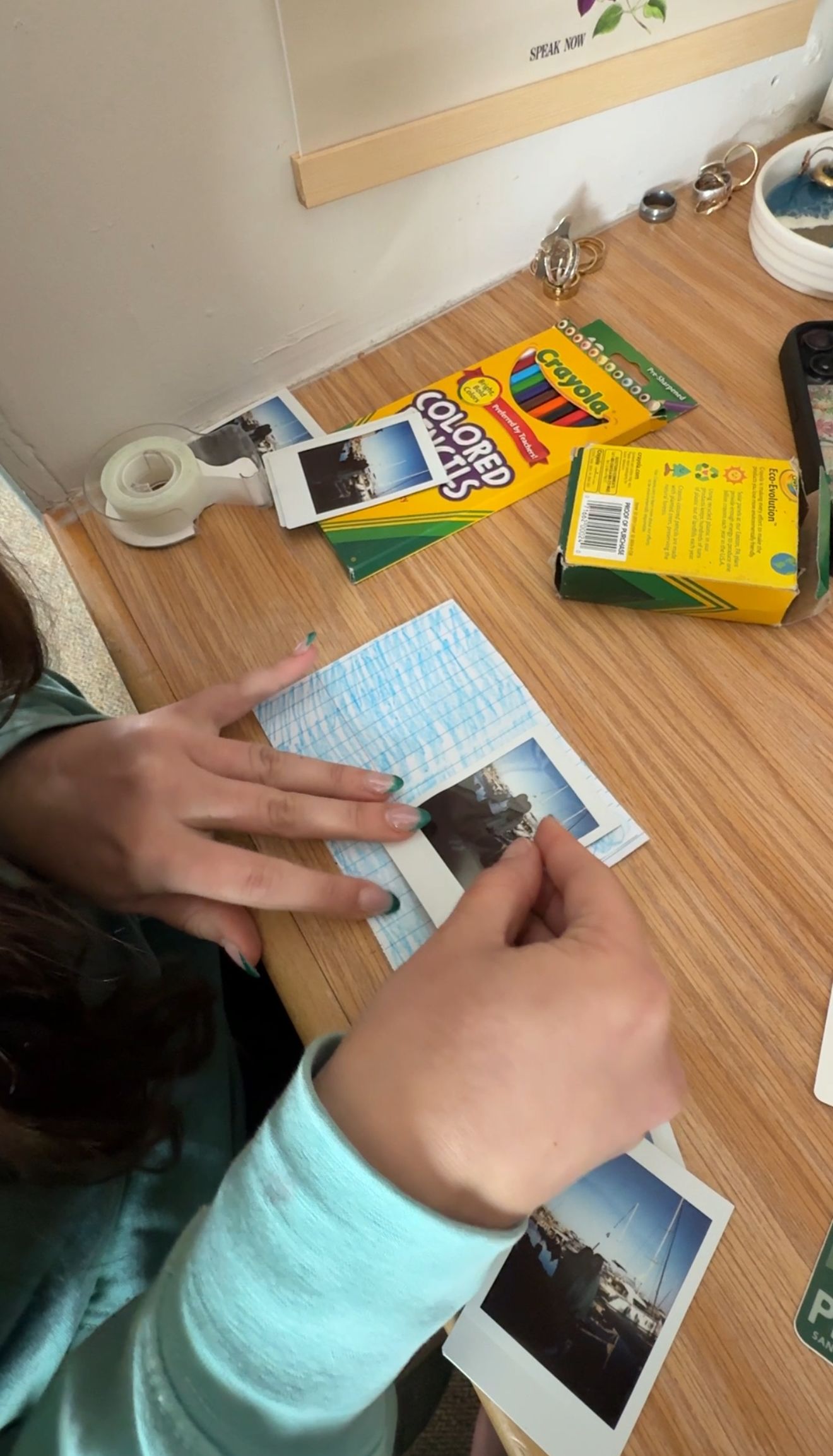
When I took that zine-making workshop, Professor Lain had each of us make our own zines. I was immediately overwhelmed by the prospect. What would I write about? How would I style it?
Was anything I had to say important enough to “publish?”
I went simple: A list of my favorite things. Not the most political or provoking, but authorship was not dictated by their presence.
Zine-making gave me the power to share the information. No barriers to entry.
 Built with Shorthand