
So, Is Theater Dead?
Theater as it is now on current college campuses, as current careers, and in current culture.
March 4. That quiet Tuesday afternoon, I stepped into Crill Hall, a performance building at San Diego’s Point Loma Nazarene University (PLNU). A week prior, I had taken a phone snapshot of the poster promoting it: “Musical Theatre Showcase.”
A Musical Theatre Showcase. By PLNU’s Voice Area. A vocal group. Performing a theater showcase.
Maybe to you it’s not strange.
But the theater major had been shut down since 2015. The Theater Club had been suspended months ago. And at that time, zero students were taking on a theater minor.
At the San Diegan private school, it seemed like theater was dead.
Seemed.
When I stepped into Crill Hall for the showcase, I saw house manager Rachel Henderson standing by the double doors leading from the lobby into the performance hall. Eventually, I could hear her talk to “Ben” on the other side of her intercom. Ben Wodarczyk was the stage manager for this performance.
One of the young performers came out to greet a group of three older individuals. These three appeared to be family members.
“Thanks for being one of the ten people here,” she said to them.
She wasn’t wrong. You probably could’ve fit everyone in the lobby into a minivan.
What’s the Point?

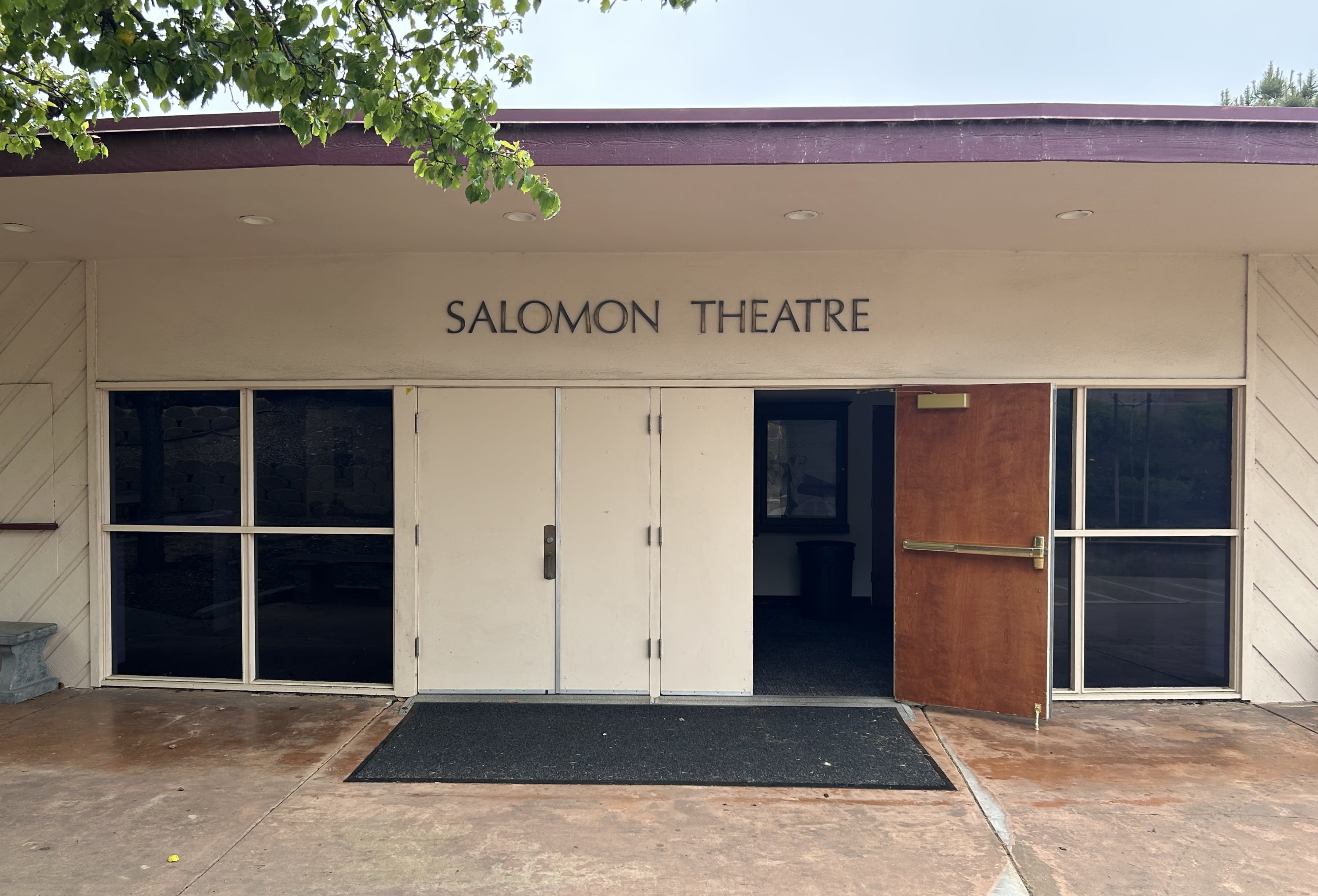
Salomon Theater was a staircase and a few long paces down the road from Crill Hall. When I stepped into Salomon Theater, a dull bluish-gray carpet greeted me with a glass case displaying four old production posters. An empty ticket booth sat on the left, and a large rectangular box stood in front of it that looked very well like a trash can but wasn’t. To the sides of the glass case ahead stood two sets of double doors leading into a pitch-black room.
A pitch-black room of aisles that poured down to a gaping stage.
Caryl Lipnick, a professor for PLNU and director of Passion for the Arts, stepped inside the theater with me. She was getting ready for her theater class to come in at 1:30. It was a Tuesday afternoon.
According to Dr. Melissa Newman, Salomon Theater sports 177 seats. When I stepped inside the theater, those seats were empty.
It’s been a couple years since Salomon Theater has had a real production.
Breanna Masters is a former PLNU student. She transferred to Cal Baptist University to pursue theater.
“Originally, I thought that Point Loma was going to have a theater minor opportunity,” she said. “Then, it wasn’t until I’d already moved in that they told me that that wasn’t offered anymore.”
Wait. So, PLNU removed their theater minor? Is that why nobody had one at the time?
Not quite.
Lily Ponce and Maddie McFarlane were part of the Theater Club before it was suspended a few months ago.
They used to be theater minors, too.
When referring to the theater minor, Henderson said, “It’s still in the catalogue, but—”
“It shouldn’t be,” McFarlane finished.
“It’s misleading … it has misled people into coming here,” Ponce said. You could hear the frustration in her voice.
“I feel kind of lied to,” McFarlane said, as she went on to describe how the school initially promoted the theater program to her.
PLNU to this day displays the theater minor on their website like it still exists.
Because, yes. It does exist.
But according to Ponce, the upper courses required for the minor are only available via independent study.
Independent study. For theater.
In a series of emails, I contacted the Dean of PLNU’s school of humanities, Dr. Lindsey Lupo. She wrote, “the last of our theater faculty retired a few years ago so we do not have faculty to teach the upper division courses.” They only have theater adjuncts.
Lily Ponce referred to the independent study in a text: “[A]fter hearing that it’s like what’s the point[?]”
Theater and the Broken World It Lives In
PLNU’s theater problem mirrors college spaces throughout the country.
The University of the Arts, which held majors for theater pursuers, suddenly shut down in June 2024 and declared bankruptcy. If you Google their website, their meta description chillingly reads, “We're closed. University of the Arts is closed as of June 7, 2024 and filed for Chapter 7 bankruptcy on September 13, 2024.” If you click on their site, it leads to an unsecure page with a red caution icon.
“None of us knew if it was real,” said Stearns Matthews, a former adjunct at UArts, in a Playbill article. “Students were sending me the Inquirer article asking if I knew if it was real. Alumni too. My phone was going nuts.”
“I got an email about applying for graduation about six hours before it was announced that the school was closing,” said Stevie Reynolds, another former student.
Journalist Kristen Mosbrucker-Garza wrote in WHYY that “[u]niversity officials blamed low student enrollment” for the closure; other factors, like the loss of accreditation, played a role, too.
But like PLNU’s theater minor removal, the communication about the conundrum was either subtle or confusing. Or both.
Meanwhile, Theatre of Arts Hollywood, an almost 100-year-old school, will close its doors in July.
A piece by HowlRound Theater Commons sees higher education in general having a hard time right now: a problem they believe involves lower birth rates, declining enrollment and insufficient funding. When the multitude and money go, it seems like the arts go first.
Jon Manning, professor of theology at PLNU, said that this is what happened to PLNU’s Theater Club, a club which he is advisor of. Only a handful of students would attend the club meetings, primarily club leaders. Lack of participation led them to shut it down . At least for now.
This happened to the theater major and minor, too. They weren’t as populous, weren’t as financially rewarding, so the University stopped investing in them. For the major, they barred students from joining it in 2015. The minor still exists, but barely.
Manning found PLNU’s theater scenario ironic, saying, “If we just add and subtract programs whenever the market dictates it … it seems detrimental to the overall goal of being liberal arts.”
But theater faces challenges on the professional stage, not just in the schools.
One of these challenges is rising production prices which lends in part to higher ticket prices. Rob Weinert-Kendt, from the magazine American Theater states that generally, 50% of a theater nonprofit’s revenue is derived from ticket sales; meanwhile, “individuals and foundations makes up most of the rest, with government funding bringing up the rear.” It doesn’t help that there’s currently “donor fatigue.”
Weinert-Kendt also found that “TCG member theatres programmed about 40 percent fewer shows in 2022-23 than they had in the 2019-20 season.” TCG, or Theatre Communications Group, is a national theater organization constructed of hundreds of theater and college members.
Another challenge relates to the audience. Deborah Gilmour Smyth is the Associate Artistic Director for the Lamb’s Players Theatre, a San Diego not-for-profit performing arts organization. She said in a phone interview, “The audiences haven’t fully come back yet,” referring to pre-COVID-19 numbers.
A Statista report shows that by 2021 and 2022, audience attendance for Broadway shows in New York sliced in half compared to the numbers in 2018-2019. Although the audience numbers have climbed back up from those record lows, they have not reached pre-COVID figures. Clearly, there is a lack of interest — “demand” — in theater productions.
Yet the stage and schools are intertwined when it comes to this “demand.” The lack of demand begins with the elementary, middle, and high schools. Smyth expressed worry about the arts being cut from school programs, beginning in primary education. She said this lack of exposure to young people would lead to less future theater participants, whether performers, stage crew or audience members.
“That’s sad to me,” Smyth said. “Not just for the arts, but for their own development and growth as humans.”
She laughed. It was a short, sad laugh.
At this rate, will the Phantom of the Opera drop chandeliers on audiences of mostly empty chairs to the sound of small, scattered cries?
Hear the People Sing
PLNU’s Musical Theater Showcase included a series of solos and small groups of singers, each singing a song from a play. Some even acted, using tantalizing choreography while others carried props, to emphasize the “Theater” in “Musical Theater Showcase.” Ezekiel Falcone, who gave us a powerful, moving, seat-clench-worthy “Confrontation” from Jekyll and Hyde, really got into it, altering his voice to mimic the terror of the song that emphasizes the slow but irresistible movement of corruption.
More than the ten originally from the lobby, the size of the audience was about thirty when the performance started, a few coming in as the doors were about to close. But as the performances gained traction, so did the audience: the audience grew naturally, with friends, faculty, and family finding home in the dark auditorium. Performers who had finished their solos shuffled back to the seats to watch their peers nail high pitches or complex melodies. The attendance grew to over sixty.
And at the end of each song, the audience, especially the singers sitting among them, would cheer and scream, sometimes in a standing ovation.
In our interview, Masters said she found theater as a place to connect with others and build relationships.
I could feel those bonds — those chords of friendship and mutual support — burst through my eardrums with the sounds of heavy claps and high-pitched shouts during that showcase.
Near the end of the Musical Theater Showcase, three of the singers came on stage to commence the song, “Do You Hear the People Sing?” from Les Misérables. As they carried their lines forward, all the singers stepped onto the stage behind them, and soon the hall echoed with cries of unity — this song sung at the height of Les Misérables’ rendition of the French Revolution, sung in community as a people stood together against government cruelty.
Video of the chorus singing, "Do You Hear the People Sing?"
Video of the chorus singing, "Do You Hear the People Sing?"
“Community is … the biggest part of theater,” Masters told me. “It’s like that phrase, ‘it takes a village.’ You can’t put on a show without the community that puts it together.”
But Lipnick sees theater as more than a community endeavor. She links it to the Great Conversation.
She explained the Great Conversation as a universal dialogue that includes all people and people groups and includes various well-known topics and ideas. Everyone can share their own experiences, opinions, and ideas about certain well-known topics in this Great Conversation, and Lipnick believes theater is a crucial part of it.
She used Wicked as an example. “Once you talk about something like Wicked, everybody has something to say about it. Everybody.”
She went on to say, “Whatever we do in a performance, we are actually pulling strings to bring people together and be able to participate in life together and see life a certain way or criticize life or simply be entertained.”
Smyth also noted theater’s place in fostering community: Stories “are so important to help us understand each other and culture and people that aren’t like us.”
Not Yet
To the hundreds of thousands of people across America and the world who join theater clubs, act in high school plays, perform in spaces like The Lamb’s Players Theater, and purchase tickets to shows like The Book of Mormon, theater is not dead.
Not even close.
“Theater right now, speaking in a global sense, is affecting more people on a day-to-day basis, and is entering the everyday culture,” Lipnick said. She referenced Lin-Manuel Miranda’s Hamilton which has heavily influenced today’s politics and art. Meanwhile, Wicked, which has recently been turned into a movie, has excited theater people everywhere; Lipnick said it is impacting children and adults alike.
But apart from affecting audiences, theater takes root in the lives of its own individual people: the performers, professors, stage crew — musicians, too.
Henderson said that her theater experience taught her public speaking.
“I don’t necessarily like public speaking —"
At this, Ponce and McFarlane laughed in unison.
“— but I actually have a really good skillset for it now because I spent so much time on stage performing.”
Ponce and McFarlane agreed with “mhmm.”
In The New York Time’s article, “Grown-Up Theater Kids Run the World,” Madison Malone Kircher listed Senator Ted Cruz, Justice Ketanji Brown Jackson, Governor Phil Murphy of New Jersey, “the editor of New York magazine” and professional athlete Anna Cockrell as former students of acting and/or theater.
“All of these power-adult former theater kids exist in a moment when the very things that used to make drama-loving teenagers an easy punchline have become strengths,” Malone wrote. “Today, performing an outsize version of oneself is often rewarded.”
But Ponce said that not everyone in theater needs to act.
Theater includes set designers, backstage crews, costume designers, and so many others who tap into non-acting skills to make a show.
“There’s so much out there that can really help an individual explore their different interests, besides acting,” Ponce said.
Of course, theater lives on through more than individuals with individual talents. It lives on through the community that carries on once the curtains close. The community that roots in individuals who carry their theater pasts with them, only expanding themselves outward and reaching the world at large.
Back to Henderson, she said that theater strengthened a second skill: writing.
“I definitely feel like theater has helped me understand my own emotions and has been a really great outlet for me to … explore that through different characters,” Henderson said. She mentioned her pursuit of a more writing-oriented career, saying that theater has empowered her to understand people better and thus write better characters, characters with varying emotions and experiences.
A third skill Henderson mentioned was empathy.
These three skills, speaking, writing, and empathy combine to “help us engage with … humanity in a really impactful way,” Henderson said. “It’s about being in communion with people.”
Lipnick has directed the San Diego theater group, Passion for the Arts, for over ten years. She has seen her students keep in touch years after a performance, even after some of those students relocate to different states or countries.
If these theater people don’t go on to win elections or NIKE partnerships, at least they’ll win friends.
Real friends.
Maybe lifelong ones.
“I’ve seen people get married out of this group,” Lipnick said excitedly. “I canno—I mean, I’ve attended their weddings—it’s incre—they’re having children!”
Not Ever?
When the Musical Theater Showcase ended, I stepped out into the lobby. Excited voices buzzed about. I chatted with Henderson about how absolutely wonderful the show was. We made a point to mention Falcone’s seat-gripping, theatrical performance of “Confrontation.”
In an article from American Theater, the authors express that “live theatre as an art form is not in danger of disappearing from the face of the earth, as theatres all over the country are proving every night (and afternoon).” These writers go on to show optimism: optimism that theater can thrive if it knows how to shape and shift with current culture.
When Lipnick and I began the interview, the theater was empty. A room that once held over a hundred people who nestled in their seats to watch some play. But when the interview would end, I would close my Windows laptop, shut off my iPhone recorder, and Lipnick would have 30 students come join her in the room for her class.
“I don’t think theater will ever die,” Lipnick said.
It’s survived thousands of years, the reshaping of countries and empire falls.
No. It probably won’t die. Probably.
Theater people will make sure it won’t.
Caitlin Callahan is a fellow creative who is earning her B.A. in writing. She writes for Fastweb as a student contributor and copyedits for a local union magazine. She grew up with both visual and verbal forms of art and hopes others can be inspired by her own art journey.
 Built with Shorthand